


Josep Suria // Shutterstock
Can doctors from other countries practice in the US?
Doctors from other countries can and do practice medicine in the United States. In fact, foreign-born physicians make up roughly 1 in 4 U.S. doctors, with an estimated 325,000 trained abroad and now working here as of late 2025.
The challenge is that practicing legally in the U.S. requires two separate things: a state medical license and a visa that authorizes you to work in the country.
For most internationally trained physicians, earning that license means passing U.S.exams, obtaining certification, and completing supervised training before treating patients on their own. A growing number of states have recently opened faster routes for experienced doctors.
Manifest Law explored the requirements for foreign-born doctors trained in another country to practice medicine in the United States.
Key Takeaways
- Foreign-trained doctors can practice in the U.S., but nearly all must earn state licensure through exams, certification, and supervised training first.
- A growing number of states now grant limited licenses that let experienced international physicians practice without repeating a full U.S. residency.
- Licensure and immigration are separate hurdles. A state license alone does not grant the legal right to work without a visa or green card.
- Physicians have several employment-based immigration options, for both short-term work and permanent residence (a green card) in the U.S.
How can foreign doctors practice in the US?
Foreign-trained doctors can generally practice in the U.S. with a valid visa and by getting a valid license from the state where they work. There is no national medical license. Each state board sets its own exams, training, and eligibility rules. Once a state grants you an unrestricted license, you can practice like any other physician, limited only by the need to keep a valid immigration status.
If you hold only a foreign medical degree or a license from another country, that credential by itself does not authorize you to treat patients in the U.S. International graduates generally must obtain certification, pass U.S. exams, and complete supervised training before a board will license them for independent clinical practice.
There are narrower exceptions. Foreign physicians can work in nonclinical roles such as research, public health, or administration without a clinical license. And as covered below, several states now issue limited or provisional licenses that let experienced international doctors practice under supervision sooner.
The process for foreign doctors to practice in the US
For most foreign physicians to practice in the United States, six steps are involved. The first five build toward a state license, and the last secures the legal right to work. The exact order and timing may shift with your country of training and your target state.
For many doctors, licensing and immigration are pursued in parallel rather than one after the other.
1. Earn a medical degree
You need a degree from a medical school recognized by the U.S. International graduates must have attended a school listed in the World Directory of Medical Schools with an ECFMG sponsor note, and must have completed at least four credit years of medical education there.
2. Get ECFMG certification (international graduates)
ECFMG certification is the mandatory gateway for international medical graduates (IMGs). You cannot enter a U.S. residency without it.
The certification confirms your medical school is eligible, verifies your diploma directly with the school, and confirms you have passed the required exams and a clinical and communication skills pathway.
3. Pass the USMLE
The United States Medical Licensing Examination (USMLE) is a three-step exam that both U.S. and international graduates must pass for an unrestricted license. Steps one and two cover the medical science and clinical knowledge and are needed for certification. Step three is usually taken during residency.
4. Complete a U.S. residency
Most states require at least one to three years of supervised postgraduate training in an Accreditation Council for Graduate Medical Education (ACGME) accredited residency, even for doctors who practiced for years abroad.
International graduates apply through the National Resident Matching Program (NRMP), also known as The Match. Placement is not guaranteed because there is often serious competition for these positions.
5. Get licensed by a state medical board
Once you meet the exam, certification, and training requirements, you can apply to the medical board in the state where you want to practice. The board reviews your credentials and issues the license. Requirements differ by state, so the same physician could qualify in one state sooner than another.
6. Secure U.S. work authorization
A state license lets you practice, but it does not give you the legal permission to stay in the U.S. International physicians who are not U.S. citizens or permanent residents also need a valid nonimmigrant visa that authorizes employment or a green card.
The process to get a visa can take a year or more, so you generally plan the visa alongside your state licensure planning.
What visa and green card options do foreign doctors have?
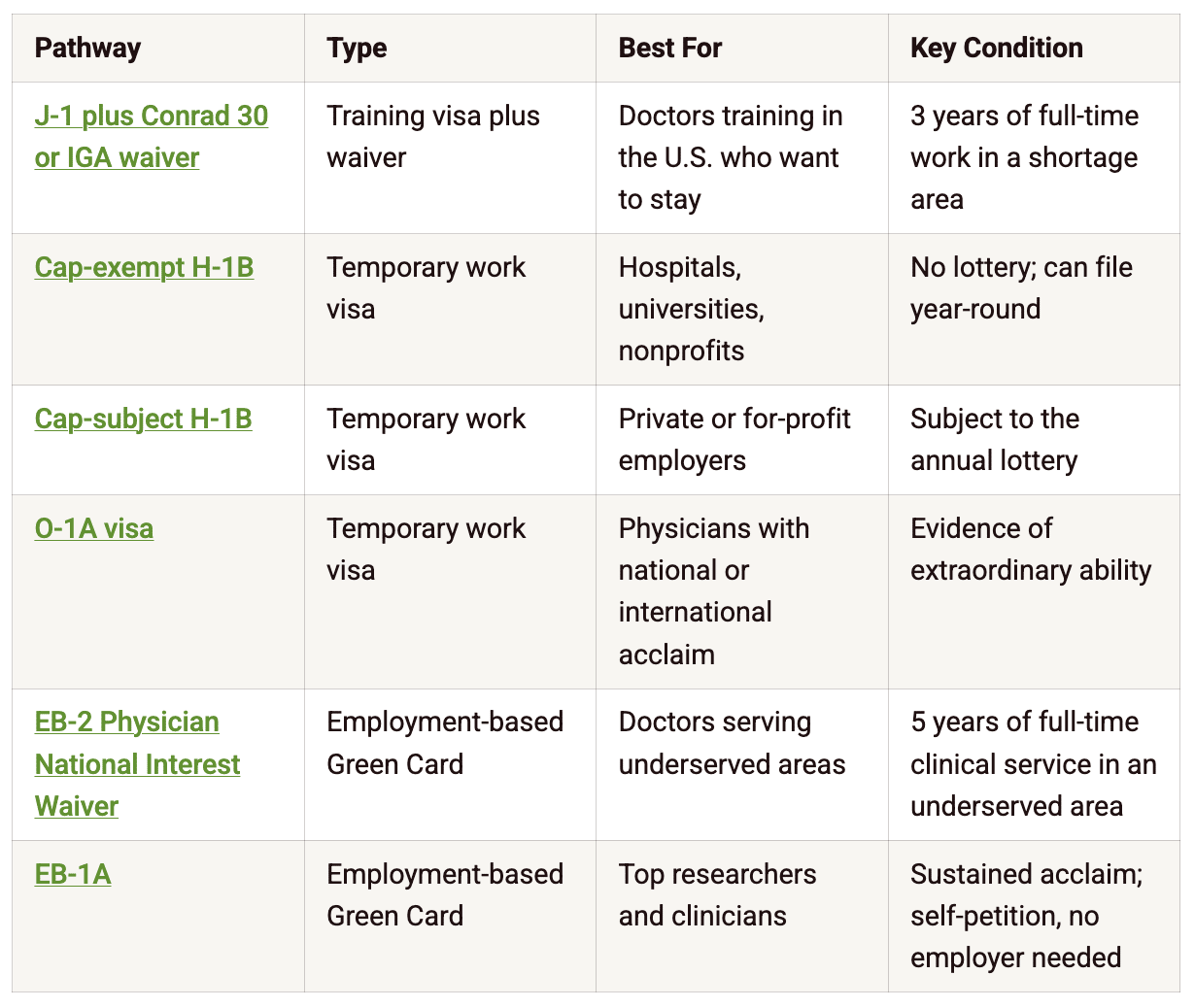
Physicians have more immigration routes than most professionals, because federal programs actively recruit doctors into underserved areas. The main options fall into temporary work visas and permanent, employment-based green cards.
Manifest Law
Example of a common path for foreign doctors
One potential path for many international physicians is to receive a J-1 visa to complete graduate medical training, clear the two-year home-residence requirement by applying for a Conrad 30 waiver tied to their work in a designated medically underserved area, move to H-1B status, and then pursue a green card through the national interest waiver as that service builds toward five years.
This is not the only path for physicians. There are multiple green card options for foreign doctors. If you’re unsure of the right choice for your situation, an immigration attorney can review your specific training, specialty, and goals before you commit to a path.
Conrad 30 waivers: Each state may sponsor up to 30 Conrad 30 waivers per year, allowing them to skip the J-1 requirement to return to their home country for two years. That said, new waivers through Conrad 30 are currently on hold unless the program receives reauthorization from Congress.
Which states let international doctors practice without a US residency?
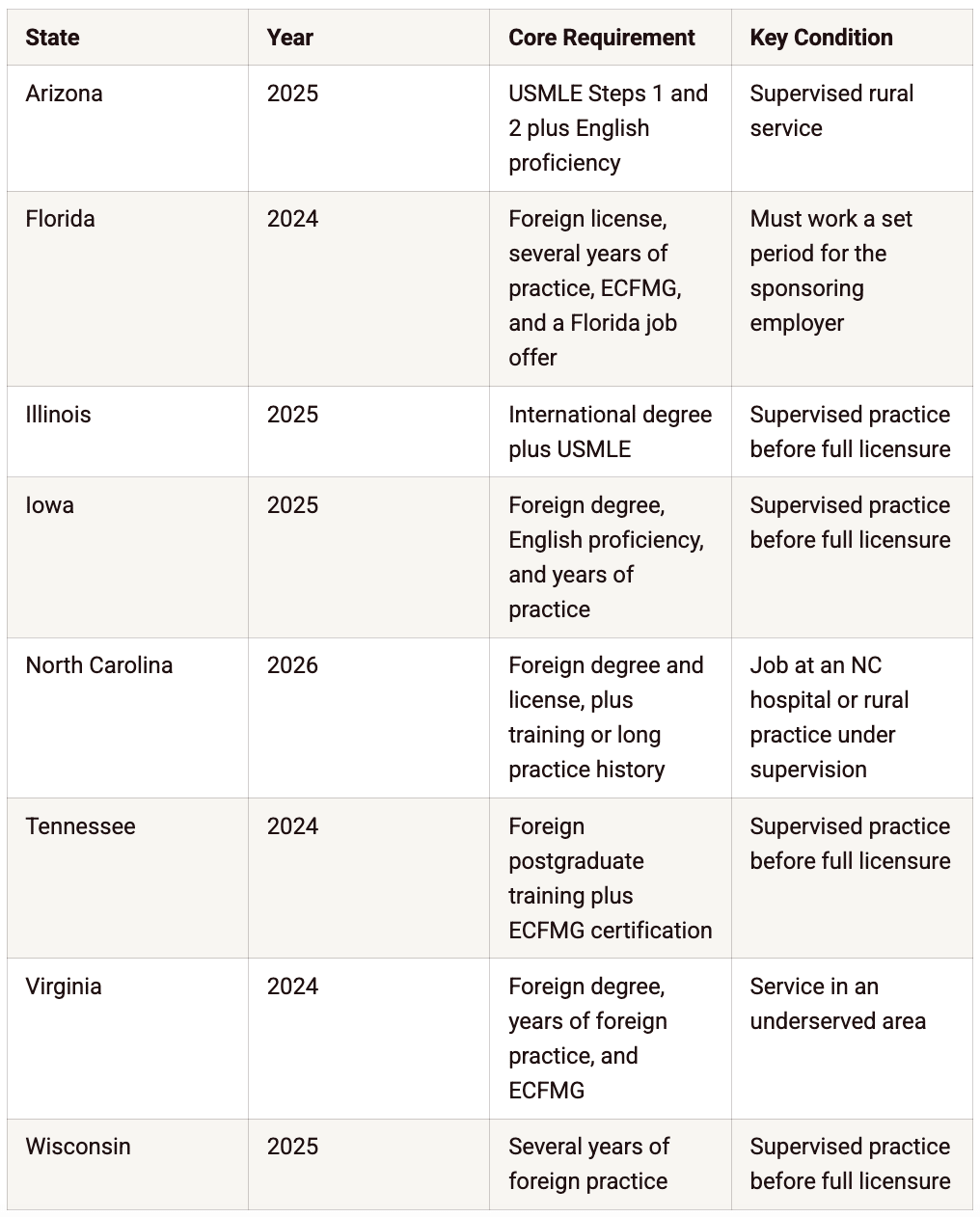
A growing number of states grant limited or provisional licenses to experienced international medical graduates without requiring a full U.S. residency. These programs are often a response to physician shortages in rural and underserved areas.
The states below target physicians who are already licensed and experienced abroad, require ECFMG certification or at least part of the USMLE, and tie the license to supervised work in shortage areas, often for two to four years before full licensure becomes available. The years reflect enactment or effective dates.
These laws are still new and may change, so confirm current terms directly with the state board. In general, these are best treated as a starting point rather than a guarantee.
Manifest Law
Plan your path to practicing in the US
Foreign-trained doctors can build a career in the United States, and the system needs them. But you’re required to clear two distinct processes at once: getting a state license to practice and applying for a U.S. visa.
New state pathways have sped up licensing for experienced physicians, but the immigration side rewards early planning.
FAQs for foreign doctors practicing in the US
Can a foreign doctor work in the U.S. without passing the USMLE?
Usually not. The USMLE is required for an unrestricted state license. The narrow exceptions are nonclinical roles and a few supervised state programs, some of which accept partial USMLE or equivalent foreign exams.
Do international doctors have to repeat residency in the U.S.?
Yes, usually. Most states require one to three years of U.S. residency, even for doctors with years of experience abroad. The main exception is the new state pathways that allow supervised practice instead.
Can you practice medicine in the U.S. with only a foreign medical degree?
No. A foreign degree alone does not authorize practice. International graduates must add ECFMG certification, the USMLE, and usually a U.S. residency before a state will license them.
How long does it take for an international doctor to start practicing in the U.S.?
Exams, the Match, and residency usually take several years before the licensing and immigration process. The new state pathways can shorten that for already-licensed, experienced physicians.
This story was produced by Manifest Law and reviewed and distributed by Stacker.

