
GA, UNITED STATES, September 22, 2026 /EINPresswire.com/ — In a major step forward in wearable technology, researchers have used machine learning to reveal how stretching flexible materials impacts their electrical performance. The study shows that pulling a material in one direction can boost conductivity by over 50%, while pulling it in another can hinder it, providing a crucial design guide for future electronic skin and sensors.
The dream of wearable electronics, like electronic skin or flexible health monitors, hinges on a simple question: what happens when you stretch them? Among the various materials being explored, molecular single crystals stand out as a promising candidate. However, the microscale mechanism governing how stretching affects the electrical performance of these specific crystals has remained a mystery.
In a study published in the journal Wearable Electronics, a team of researchers from Tsinghua University and Nanyang Technological University describes a new approach combining molecular dynamics with machine learning to map the relationship between strain and charge mobility. By clarifying microscopic mechanisms, the study contributes to the rational design of robust organic crystals that maintain high performance under the mechanical deformations typical of wearable applications, paving the way for next-generation skin-mountable sensing and computing systems.
“Flexible electronic components are prone to mechanical stresses, such as stretching and bending, during operations,” explains senior and corresponding author Shuzhou Li. “Ensuring their seamless functionality necessitates both excellent flexibility and reliable electrical performance.”
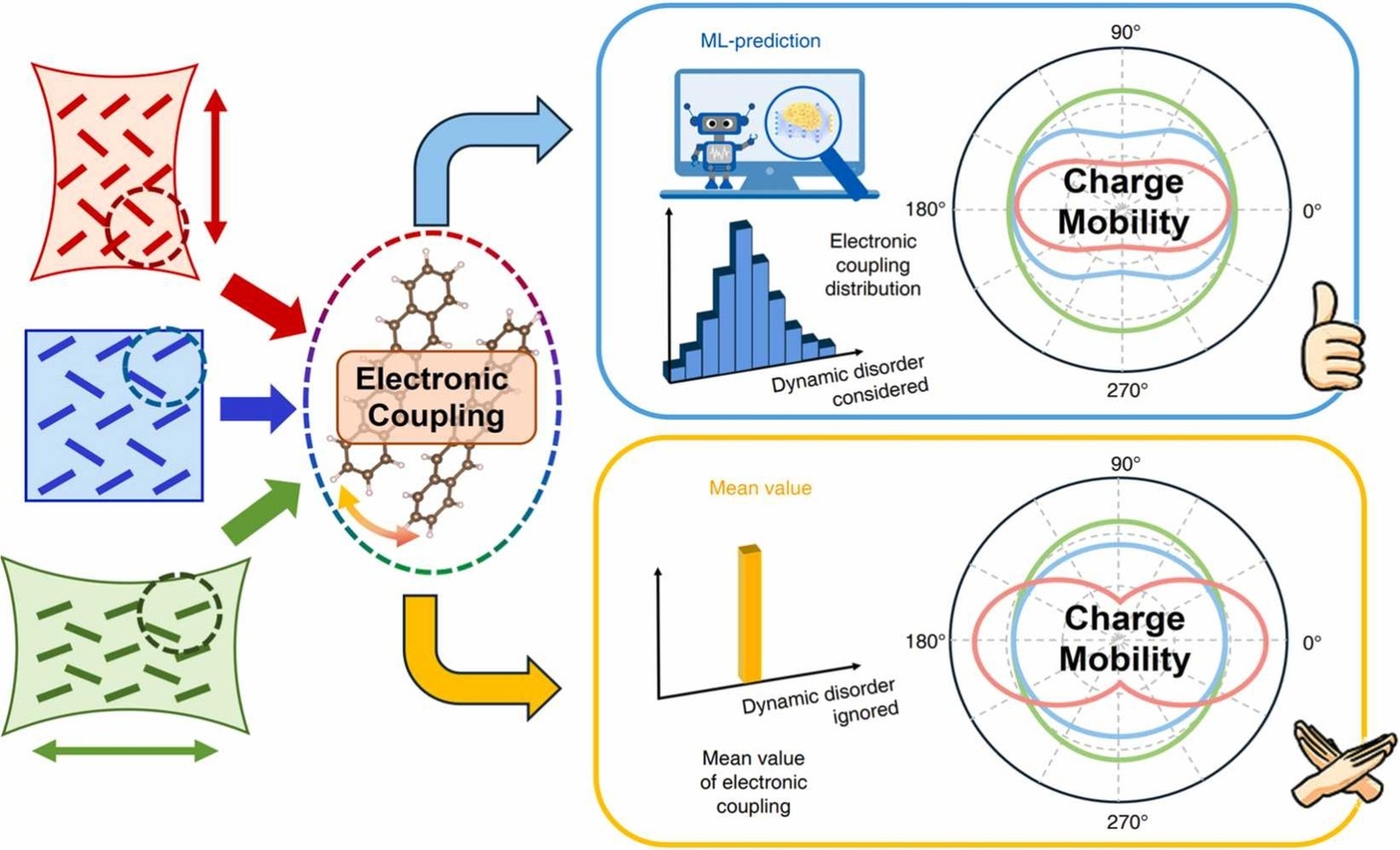
At present, the microscale mechanism governing the dependence of electrical properties on tensile strain requires clarification. The team’s solution was to create a machine learning model that could predict the electronic coupling—the ease with which an electrical charge can jump between molecules—from their structural arrangement. “By simulating the effects of stretching on a common organic semiconductor called pentacene, the model could reveal how the material’s internal “traffic patterns” for electricity changed under stress,” Li adds.
The team observed that a 5% tensile strain along the crystal’s a-axis enhanced charge mobility by 55% along the b-axis. Conversely, a 5% strain along the b-axis reduced mobility by 33%. Topological analysis showed that a-axis strain pulled molecules closer together, creating a more efficient transport network, while b-axis strain pushes them apart, hindering the flow of charge.
“The results indicated that strain along the b-axis significantly enhances molecular motion, broadening the distribution of electronic couplings and further limiting charge transport,” says lead author Xi Chen. “This finding clarifies the boundaries of applicability for simpler models that neglect this dynamic effect, which can lead to inaccurate predictions.”
References
DOI
10.1016/j.wees.2026.06.001
Original Source URL
https://doi.org/10.1016/j.wees.2026.06.001
Funding information
This work was supported by the MOE Academic Research Fund Tier 1(RT9/23) and Tier 2 (MOE-T2EP10224-0003).
Lucy Wang
BioDesign Research
email us here
Legal Disclaimer:
EIN Presswire provides this news content “as is” without warranty of any kind. We do not accept any responsibility or liability
for the accuracy, content, images, videos, licenses, completeness, legality, or reliability of the information contained in this
article. If you have any complaints or copyright issues related to this article, kindly contact the author above.

Media gallery