

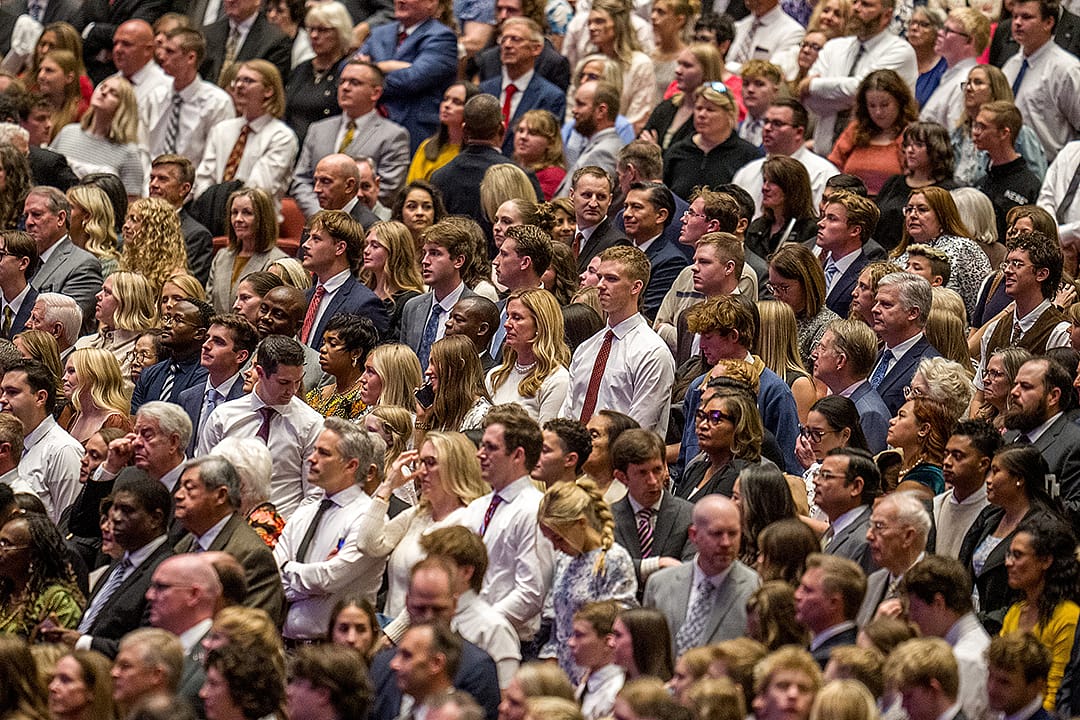
Trent Nelson // The Salt Lake Tribune
For Latter-day Saints, the retention decline is more than a people problem
In a video clip that has ricocheted across social media about The Church of Jesus Christ of Latter-day Saints, a retired high-level leader chastises fellow members considering departing the faith, admonishing, “Darth Vader could be your bishop,” he states, “the culture could be like Alcatraz, and it will not drive you away.”
Lawrence Corbridge, who served as a general authority Seventy from 2008 to 2019, doesn’t stop there.
“Some claim church culture is driving people away,” he continues. “The members feel unseen, disconnected, empty and the solution they say is a transformation to a more open, inclusive, transparent, loving and tolerant culture wherein more people can comfortably gather.”
But that, he argues, misses the point entirely.
“The ultimate question is not, ‘Do I fit in?’” he explains in the video, part of a series produced by the independent advocacy organization Scripture Central. “The ultimate question is: Is the church true?”
If the answer is yes, he concludes, tears brimming in his eyes, “then you will stay — come what may.”
Part plea and part exhortation, the message comes at a time of reckoning as headlines flash the same dire warning: The faith, heralded by experts as recently as the 1990s as on track to becoming one of the world’s dominant religions, is failing to retain a growing number of its U.S. members, The Salt Lake Tribune reports.
The church is far from alone in confronting this problem. Nonetheless, the phenomenon carries a special sting for the missionary-minded faith, say scholars of Mormonism, who argue it represents not only a people problem, but, as a religion that views itself as the one and only true church, also a theological knot in need of untangling.
Reflecting on the messages he heard growing up in the quickly expanding church of the 1980s and ’90s, Latter-day Saint historian Patrick Mason recalls, “it wasn’t always so crass as to say because we’re growing fast we are true. But oftentimes it was only a half step away from that.”
For a faith that views itself as the answer to biblical prophecy and the only “true and living” church on earth, growth was a sign of God’s favor. So what does it mean now that it has slowed?
A look at the numbers
To be sure, the news isn’t all grim for the Utah-based faith of 17.8 million members.
In July, the church set a new record for the number of full-time missionaries, although whether this represents the beginning of a trend or a high-water mark remains to be seen. And, in 2025, it enjoyed the largest number of convert baptisms (385,490) in its 196-year history.
But attracting new adherents is one thing. Keeping them is another.
Retention is not a new challenge. Research suggests that, as of the late 20th century, only about a quarter of international Latter-day Saint converts and half of U.S. converts were attending church a year after baptism. And as independent researcher Matt Martinich pointed out in a “Mormon Land” podcast episode this spring, retention beyond that year mark is — and was — a far greater challenge.
“The problem is after two years, five years, 10 years, that number goes down substantially,” Martinich said. “So the bigger problem is retention for the medium to long term.”
What appears to be new is the degree of decline among those born in the faith who remain actively engaged as adults.
A slew of recent analyses and studies, including one from church-owned Brigham Young University, agree: Roughly half of U.S. members raised in the church continue to claim membership as adults.
Zoom in on those attending meetings with some regularity and the number drops to about 4 in 10, and even fewer for Generation Z women. In fact, women are now more likely to leave the fold than men, the BYU report observes.
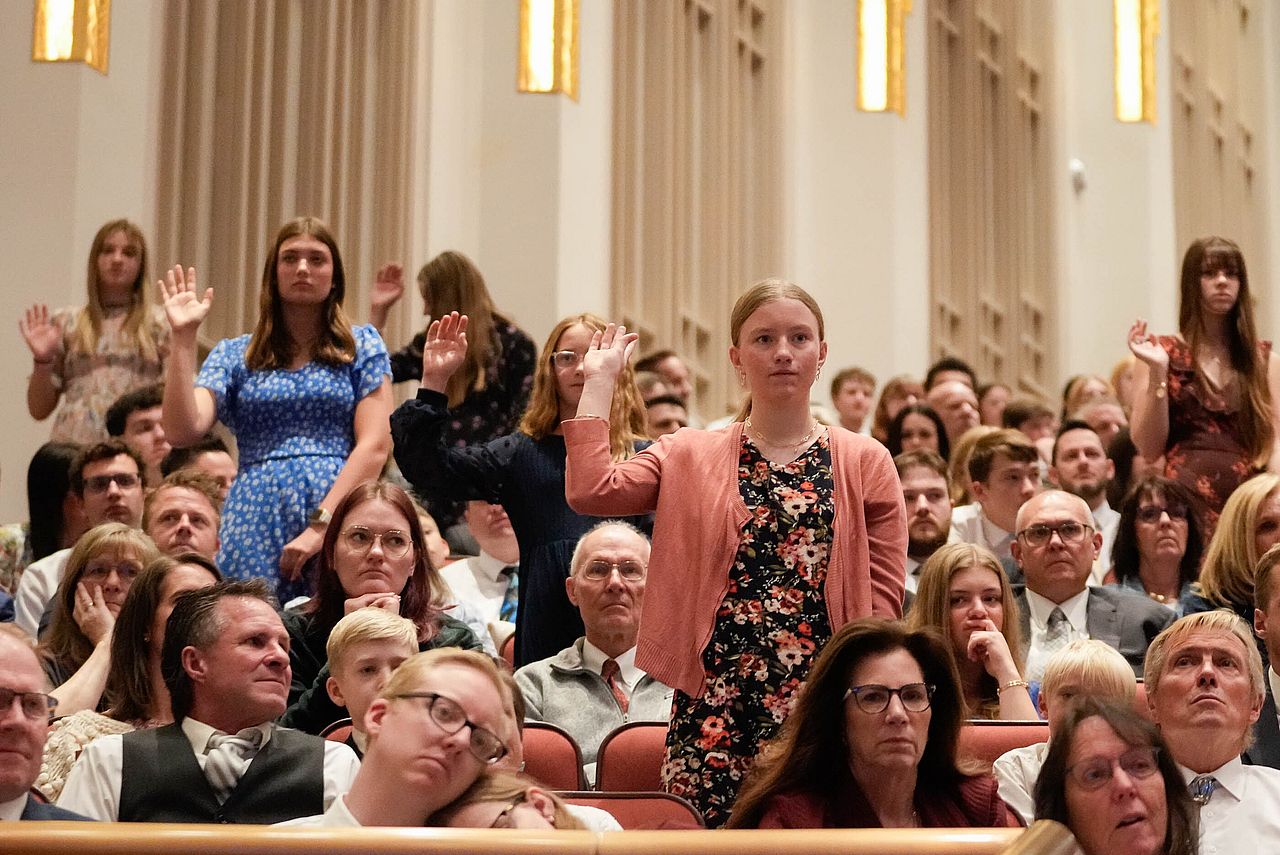
Francisco Kjolseth // The Salt Lake Tribune
Compare those numbers to an estimated 8 in 10 just a few decades ago, when sociologist Rodney Stark declared that the church was on track to boast 63 million to 265 million members by 2080.
“You had these statistics,” Mason, chair of Mormon history and culture at Utah State University, explains, “that validated this internal theological narrative that this was the place where God was really doing his work in the world.”
Fast-forward to today and the church has yet to crack 18 million.
Are liberal politics and social media to blame?
If church leaders have settled on a narrative to explain this downshift, Latter-day Saint historian and writer Kristine Haglund hasn’t heard it.
“The failure to develop a coherent response is part of the problem,” she muses. “It conveys we don’t care, which I don’t actually think is true. Still, its absence can feel like neglect.”
Within that vacuum, she says, “one-off” sentiments emerge — some better informed than others but none actually representative of “an institutional position.”
Case in point: Corbridge’s declaration that “belief trumps discomfort.”
Mason has described watching a range of framings emerge from unofficial sources, mostly focused on the outside world and its supposed decay.
In an op-ed for the church-owned Deseret News, for instance, BYU religion professor Barbara Morgan Gardner points to social media and liberal politics, blaming them in particular for the decline of membership among young women.
These forces, she argues, are saturated in beliefs that prize the individual over the community and are inherently suspicious of institutions.
“Can you see,” the co-author of the recent BYU report on retention writes, “why it may be difficult for a Latter-day Saint millennial woman embracing these philosophies popular among peers to stay committed to a faith tradition that is at odds with much of the prevailing cultural zeitgeist of the day?”
Pro-church social media accounts, meanwhile, are rife with messages accusing feminists, “activist therapists” and “woke ideology” for peeling away the young while also infiltrating and corrupting church culture, thus driving away would-be faithful members.
A predicted outcome
At the same time, feminists who have been predicting for years that a downturn among women loomed argue the church itself shoulders much of the blame.
“Reported membership loss must be understood in the context of five decades of significant institutional pressures on Mormon women,” scholar Joanna Brooks, author of “The Book of Mormon Girl,” says, listing as examples everything from the church’s policing of women’s bodies and fashion to its opposition to the Equal Rights Amendment.
Heather Sundahl, co-author of “50 Years of Exponent II,” offers a similar explanation, stressing that young women today are more attuned to — and put off by — gender imbalances than their predecessors.
“I can remember teaching about the Godhead in Primary,” she says, referring to the church program for children, “and one girl commenting in frustration, ‘So what you’re saying is a ghost can be part of the Godhead but not a girl?’”
Latter-day Saint theology teaches that the Holy Ghost, or Holy Spirit, is part of the three-member Godhead along with Heavenly Father and Jesus Christ.
Celebrating new metrics
The way Mason sees it, there is one step church leaders have taken to at least refocus the narrative of growth and any challenges to it.
“If you believe that truth is associated with progress and that more is better,” he says, “then you’ve got to come up with another metric. And I think that’s exactly what President Russell M. Nelson gave the church with temple building.”
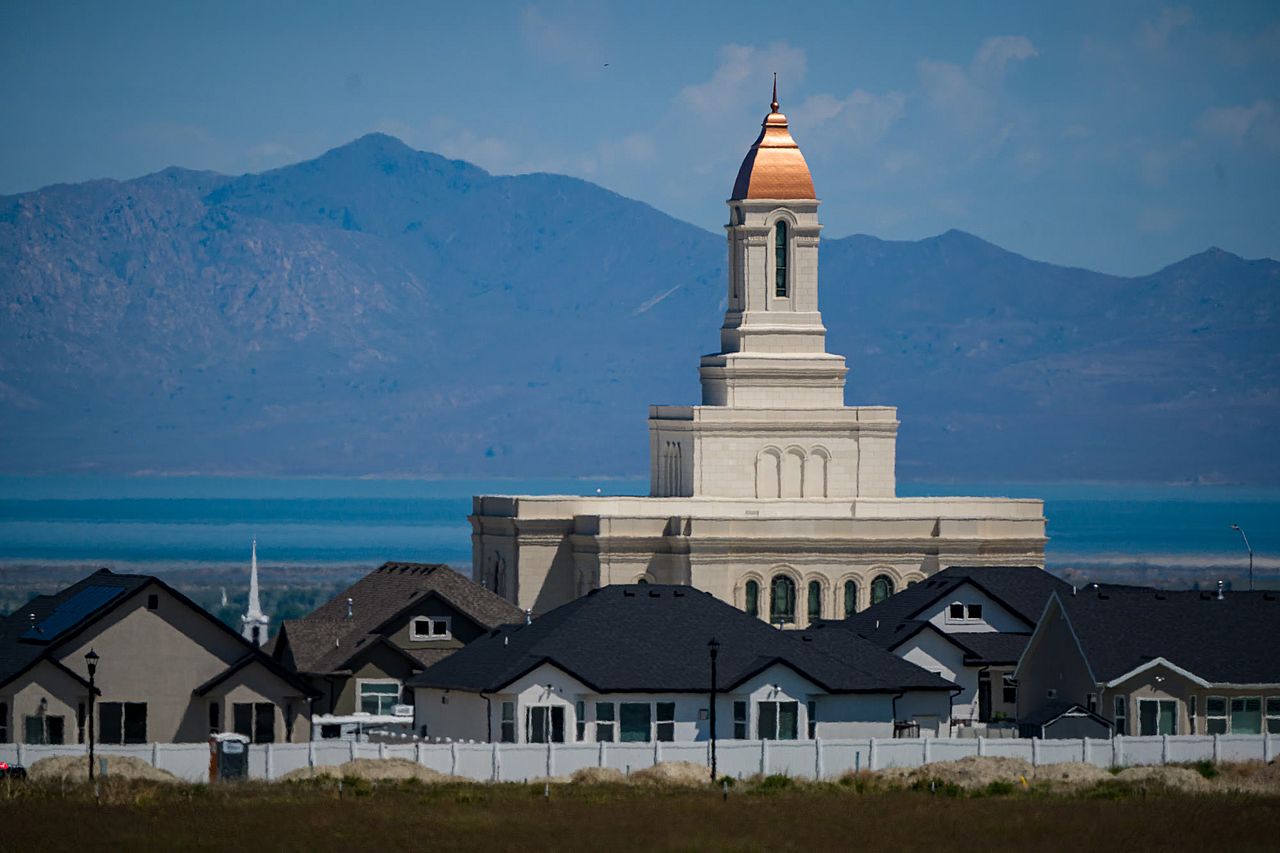
Trent Nelson // The Salt Lake Tribune
The former leader announced 200 new edifices, accounting for more than half the faith’s 385 existing or planned temples.
His successor, President Dallin H. Oaks, is taking a different route, nixing the practice of announcing new temples at General Conference in favor of breaking the news at regional meetings where the sacred buildings would be located.
Instead, Mason observes, his interest seems to be in promoting growth metrics that deal specifically with youth retention — the number of missionaries serving, for instance.
“There always has to be something that you can hang your hat on as the good news,” Mason says. “I think this is both external-facing, but also internal-facing, a way to rally the troops and get people to feel good about the enterprise.”
This story was produced by The Salt Lake Tribune and reviewed and distributed by Stacker.

