

Key Takeaways
- Vertical climbers burn 600-800 calories per hour by engaging every major muscle group – arms, legs, core, and shoulders – simultaneously, making them one of the most efficient cardio machines available.
- Frame stability, resistance type, and ceiling clearance are the three factors that separate a great vertical climber from a frustrating one – and most buyers overlook at least one of them.
- Magnetic resistance systems consistently outperform hydraulic alternatives in smoothness, durability, and long-term progression for serious home gym use.
- Beginners can use vertical climbers safely with the right starting approach; read on for exactly how to ramp up without burning out.
Vertical climbers have earned a reputation as one of the most demanding – and rewarding – machines in any gym. The question is which one actually belongs in a home gym, and which ones look great on paper but fall short under real use.
Below is a clear-eyed look at what makes these machines work, what to watch for before buying, and how the top 2026 models stack up.
Vertical Climbers Burn Up to 800 Calories Per Hour – Here’s Why
Most cardio machines are partial-body workouts disguised as full-body ones. A treadmill pushes the legs. A stationary bike does the same. Even rowing machines, while more complete, still lean heavily on the back and lower body. Vertical climbers are built differently from the ground up.
When climbing, the arms pull down while the legs push up – simultaneously. The core braces throughout every stroke to keep the body stable. That coordinated effort across multiple large muscle groups creates an unusually high metabolic demand. According to the Cleveland Clinic, high-intensity sessions on a vertical climber can burn between 600 and 800 calories per hour, a figure that outpaces most traditional cardio equipment. Beyond calorie burn, that same full-body engagement builds aerobic capacity and functional strength at the same time – a combination that is rare from a single machine.
Adding to the appeal: vertical climbing is low-impact. Feet stay in contact with the pedals throughout the entire movement, so there is no repetitive pounding on the joints. That makes it viable for a wide range of fitness levels, including those who find running or jumping uncomfortable.
What Separates a Great Climber From a Mediocre One
Not every vertical climber delivers on the promise. A few key specs reveal whether a machine will hold up to serious use – or wobble, squeak, and frustrate within a few months.
Frame Stability and Weight Capacity
Frame quality is the single most important factor to evaluate. A climber that flexes or wobbles during an intense session is both unsafe and distracting. Welded steel frames with weight capacities in the 350-400 lb range provide the structural rigidity needed for hard efforts. Lighter aluminum or tube-steel frames offer portability and lower price points, but they flex more and typically support less weight – a real limitation for users above 250 lbs or those who plan to train at high intensity regularly.
Magnetic vs. Hydraulic Resistance
Resistance type shapes the entire feel of the workout. Magnetic resistance – specifically eddy current brake systems – delivers smooth, consistent tension that can be adjusted precisely mid-workout. Quieter and more durable, it suits interval training where resistance changes frequently. Hydraulic resistance, common in budget models, works through fluid compression. Functional and more affordable, the feel is less consistent, the adjustment range is narrower, and the system tends to wear faster under heavy use. For long-term progression, magnetic wins.
Space Needs: Footprint vs. Ceiling Clearance
Vertical climbers have a smaller horizontal footprint than almost any other major cardio machine – a genuine advantage for compact home gyms. The ceiling, however, is where most buyers get caught off guard. A general rule: take your height, add 12-18 inches for arm extension overhead, then factor in the machine’s pedal height at full stride. Most users need a minimum of 8 feet of ceiling clearance, and taller users may need 9-10 feet. Measure before purchasing – no exceptions.
The 3 Top-Rated Vertical Climbers Reviewed
After evaluating build quality, resistance systems, user experience, and long-term value, three machines rise to the top in 2026.
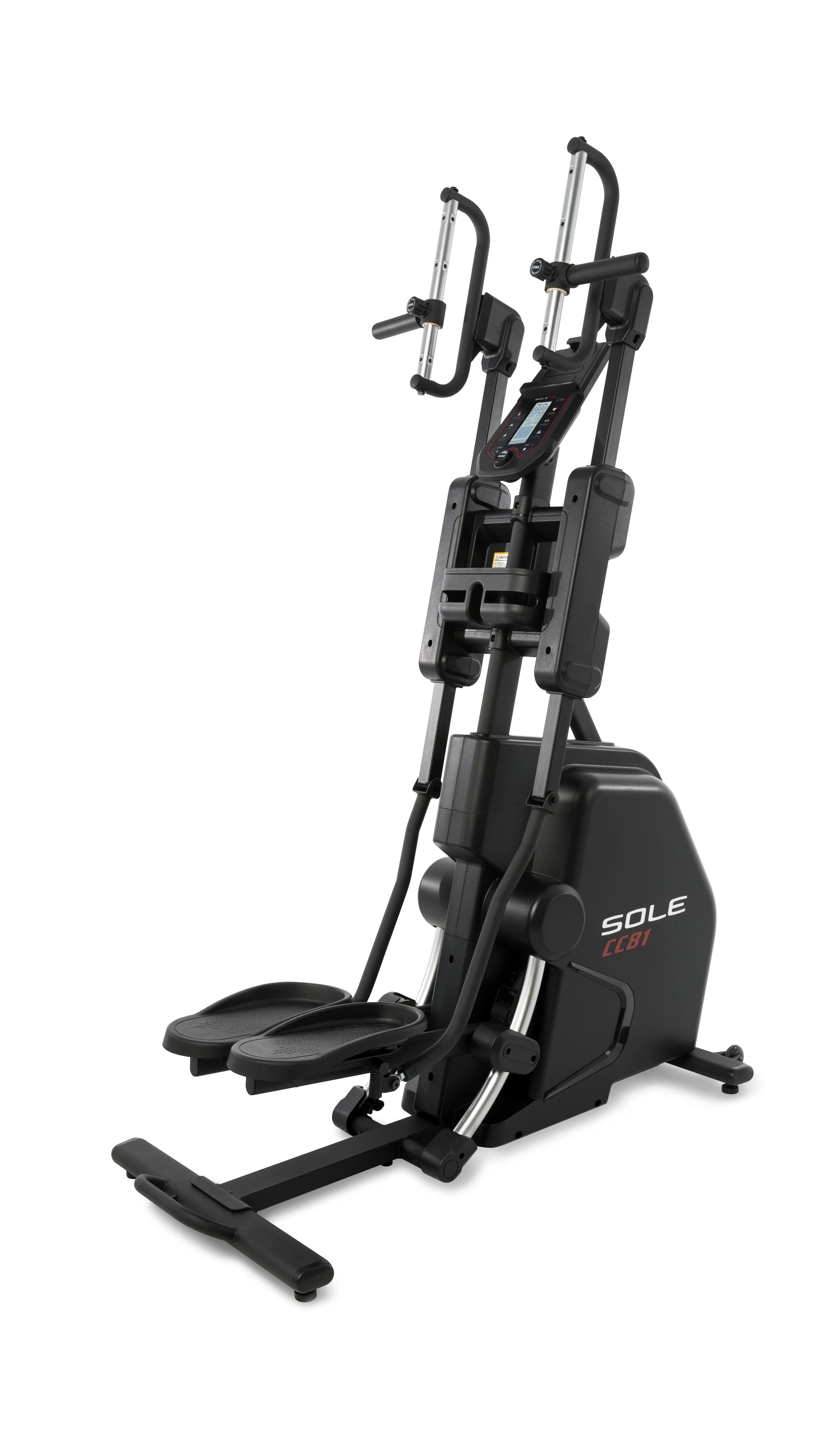
SOLE CC81 Cardio Climber – A Top-Tier Commercial-Grade Pick
The SOLE CC81 Cardio Climber takes a hybrid approach – combining stepping and climbing movements into a single fluid motion – rather than mimicking a strict vertical track. That design choice makes it more accessible to beginners while still delivering a punishing full-body workout for experienced users.
The foundation is a 25 lb flywheel paired with 20 levels of eddy current brake (ECB) magnetic resistance. The result is smooth, consistent momentum at every intensity level, with easy mid-session adjustments via the console knob – ideal for interval training. The all-steel welded frame supports up to 400 lbs and weighs approximately 220 lbs (net weight), creating a stable, no-wobble platform even during hard efforts.
The 4-position adjustable handlebars deserve specific attention. Beyond height adjustment, the handles rotate to shift muscle targeting – front-facing hits the biceps and triceps, while outward-facing recruits the deltoids and shoulders. The pedals are built with a 2-degree inward slope to reduce joint stress at the ankle and knee. The machine stands 86 inches tall, so ceiling clearance should be confirmed before ordering.
The 5 x 3-inch LCD console tracks time, speed, distance, resistance level, calories, heart rate, vertical meters, and steps per minute. Ten built-in programs – six preset, two custom, two heart rate-controlled – provide structured variety. Bluetooth connectivity syncs data to the SOLE+ App, which typically integrates with popular fitness platforms like Apple Health, Fitbit, and MapMyRun. The included wireless chest strap enables accurate heart rate monitoring. The free SOLE+ App adds hundreds of coached workouts with no subscription fee, ever.
VersaClimber SM Sport Model – Best Pure Climber
VersaClimber is one of the original names in commercial vertical climbing, and the SM Sport Model brings that legacy to home users. The 75-degree climbing angle creates a near-vertical body position that closely replicates actual climbing mechanics, with arms and legs moving in contra-lateral patterns – opposite arm and leg together – for a highly coordinated full-body effort.
Step height and arm travel are each adjustable from 1 to 20 inches, offering a wide range of stride options across fitness levels and training styles. For the standard VersaClimber SM Sport Model, resistance comes from variable tension, meaning intensity is primarily driven by climbing speed and stride length. A VersaClimber SM-Magnetic model is also available, which features 11 levels of adjustable magnetic resistance controlled by a dial. An interactive module provides voice coaching, virtual opponents, and the ability to climb famous structures for goal-based motivation. The SM Sport Model requires a 110 Volt AC power supply. At 150 lbs with a 350 lb weight capacity, the SM Sport is lighter than commercial-grade magnetic machines but built from hand-welded steel. The 3-year frame warranty reflects solid construction confidence.
MaxiClimber XL-2000 – A Strong Budget-Friendly Contender
For users who want to test vertical climbing without a major investment, the MaxiClimber XL-2000 is the most practical entry point. The aluminum frame weighs approximately 52 lbs and folds to 14 x 26 inches for storage – a genuine advantage for small spaces. Twelve levels of bi-directional hydraulic resistance provide progressive challenge as fitness improves, a step up from bodyweight-only budget options.
Height adjustability accommodates users up to 6’6″, and the 300 lb weight capacity covers most home users. The free MaxiClimber Fitness App includes coach-led workouts accessible via the integrated device holder. Trade-offs are real: hydraulic resistance feels less smooth than magnetic, the aluminum frame flexes more noticeably under load, and the 30-day satisfaction guarantee is far shorter than the multi-year warranties on premium machines. For budget-conscious beginners, though, it delivers genuine value.
Common Questions Before You Buy
Can Beginners Use Vertical Climbers Safely?
Yes. Vertical climbers are safe for beginners, but the learning curve is steeper than most cardio machines because the whole body is working at once. Starting with 5-10 minute sessions at the lowest resistance setting allows the body to adapt without overloading. Building gradually – adding 5 minutes or one resistance level per week – leads to sustainable progress.
How Much Ceiling Clearance Do You Really Need?
The minimum is 8 feet for most users, but that is a floor, not a target. At full stride, arms extend significantly overhead. A 6-foot user typically needs around 8.5-9 feet; taller users should plan for 9-10 feet. Always measure the actual ceiling height in the intended room – not an estimate – before purchasing any vertical climber.
Get Gym-Grade Performance At Home
Vertical climbers offer something genuinely rare: a single machine that builds cardiovascular fitness and functional strength simultaneously, with a low joint-impact profile and a compact footprint. The gap between a quality machine and a frustrating one comes down to frame construction, resistance type, and honest space planning. For home gym owners who want durability, smooth progressive resistance, and the long-term confidence of a strong warranty, those factors consistently point toward commercial-grade construction over budget alternatives.
SOLE Fitness
56 Exchange Pl.
Salt Lake City
UT
84111
United States
