
Residential vs. Commercial Attic Insulation: Key Differences Business Owners and Managers Must Consider
Okotoks, Canada – January 30, 2026 / Eco Attic Solutions Inc. /
Calgary, AB – Eco Attic Solutions Inc. warns Alberta business owners against applying residential insulation methods to commercial buildings. These errors lead to poor performance and non-compliance with commercial standards, which require specialized materials, fire-rated systems, and code-specific expertise. Commercial buildings use about 12% of Canada’s total energy, and under-insulated facilities waste more per square foot due to larger roof areas, longer hours, and frequent air exchange.

Scale Requirements Separate Commercial Projects from Residential Work
Physical scope differences between residential and commercial insulation create distinct project demands. Average Calgary homes contain 1,200-3,000 square feet of attic space, while commercial buildings typically feature 5,000-50,000+ square feet of roof systems requiring specialized installation approaches.
Commercial roof decks present structural considerations absent in residential applications. Many commercial buildings utilize flat or low-slope roof systems with different load-bearing capacity requirements that must support insulation weight plus HVAC equipment 3-5 times larger than residential systems. Building height often requires scissor lifts or boom equipment rather than simple ladders, with safety protocols demanding fall protection systems and coordination with building operations.
Fire Safety Standards and Material Certification Requirements
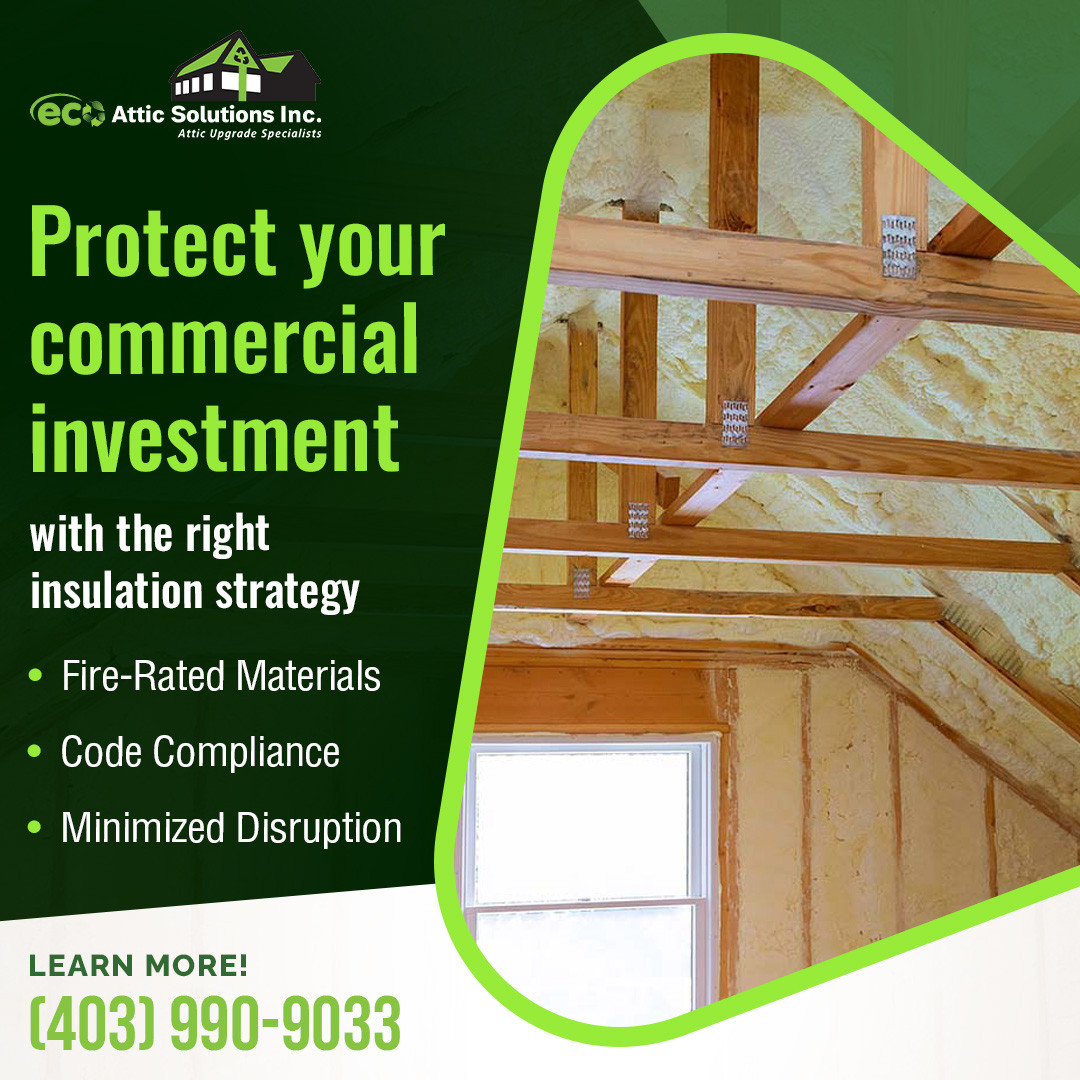
A qualified commercial insulation contractor like Eco Attic Solutions must specify materials meeting the National Building Code of Canada fire performance criteria, which establish specific requirements for fire resistance, flame spread, and smoke development ratings appropriate to building occupancy and construction type. Material manufacturers must provide third-party testing documentation certifying these ratings.
Commercial-grade insulation materials include:
-
Closed-Cell Spray Foam: Delivers R-6 to R-7 per inch while functioning as both insulation and air barrier, with rigid structure adding roof deck stability
-
Rigid Foam Boards: Offer R-5 to R-6.5 per inch with fire-rated options engineered specifically for commercial applications
-
Mineral Wool: Achieves fire-resistance ratings up to 2 hours while maintaining R-value even when exposed to moisture
-
High-Density Blown Insulation: Commercial-grade fibreglass products deliver R-4+ per inch, exceeding residential formulations
Thermal Performance Standards for Calgary’s Climate Zone
The National Energy Code for Buildings (NECB) establishes minimum insulation requirements for commercial roof assemblies that vary by climate zone and building type. Commercial roof insulation requirements in Calgary are determined by performance modelling paths under the National Building Code of Canada, which define energy performance targets via U-values and modelled energy use.
Eco Attic Solutions Inc. understands that building type determines ideal insulation levels based on heating demands, occupancy patterns, and operational requirements:
|
Building Type |
Recommended R-Value |
Approx. Heating Cost Reduction |
|
Warehouse/Industrial |
R-30 to R-40 |
20-25% |
|
Retail Space |
R-40 to R-50 |
25-30% |
|
Office Building |
R-50 to R-60 |
30-35% |
Upgrading roof insulation for commercial buildings can reduce heating costs substantially. However, the magnitude of savings for any specific property varies based on energy costs, usage patterns, and insulation assembly details. An energy audit or modelling provides accurate estimates for individual facilities.
Investment Analysis and Payback Calculations
Material costs for commercial attic insulation in Calgary depend on factors like insulation type, building access, safety protocols, and overall project complexity. Larger projects naturally involve greater investment, with expenses scaling based on building size and usage.
Additional costs may include permits, inspections, fire safety documentation, and asbestos testing for older buildings. Businesses opting for after-hours installation may face premium charges to avoid operational disruptions.
Proper insulation upgrades offer long-term financial benefits. Many commercial properties experience noticeable heating cost reductions and operational savings over time, often resulting in favourable payback periods. Eco Attic Solutions emphasizes that well-insulated commercial buildings typically hold stronger value thanks to lower energy use and reduced wear on HVAC systems.
Contractor Selection Criteria for Commercial Projects
Selecting an appropriate commercial insulation contractor requires verification beyond checking online reviews or comparing basic quotes. WCB (Workers’ Compensation Board) coverage for all crew members represents the foundation of legitimate commercial operation. General liability insurance must provide a minimum of $2-5 million coverage for commercial projects.
Portfolio review reveals contractor capabilities through photos and project details from at least three completed commercial projects similar in size and building type. Familiarity with the National Building Code and Alberta Building Code commercial requirements separates qualified contractors from those learning during your project.
Red flags include contractors whose portfolios show primarily residential work, absence of commercial insurance coverage, and unwillingness to provide material certifications suggesting intent to substitute residential-grade products lacking required fire ratings.
Installation Timeline and Operational Disruption Management
Project duration planning affects business continuity. Small commercial facilities (5,000-10,000 square feet) typically require 3-5 working days, while large commercial structures (25,000+ square feet) demand 10-14+ working days. After-hours installation during evenings and weekends suits retail operations and office buildings where daytime work would disrupt customers or employees.
Dust control systems using commercial-grade air scrubbers with HEPA filtration protect inventory and equipment from insulation particulates. Professional contractors build installation schedules around business operational needs rather than crew availability, recognizing that minimizing disruption provides value beyond the physical installation.
Schedule Your Commercial Building Thermal Performance Assessment

Eco Attic Solutions Inc. specializes in commercial insulation service for warehouses, retail centers, office buildings, and industrial facilities throughout Calgary, Okotoks, Cochrane, Airdrie, and surrounding Alberta areas. The team understands unique requirements separating commercial projects from residential work, including proper material selection with fire-resistance ratings, National Building Code compliance, installation, scheduling, and minimizing business disruption.
Free thermal imaging assessments identify current insulation deficiencies with detailed ROI analysis showing projected energy savings based on specific building characteristics. Services include fire-rated material specifications meeting NBC requirements, installation scheduling options including after-hours and phased approaches, and complete code compliance documentation for permits, inspections, and insurance requirements.
Contact Eco Attic Solutions at (403) 990-9033 or admin@ecoatticsolutions.com to schedule your commercial building assessment. The company handles the complete project scope from permit applications through final inspections, allowing businesses to maintain operational focus while improving thermal performance and reducing long-term operating costs.


Contact Information:
Eco Attic Solutions Inc.
2018 402 Ave W
Okotoks, AB T1S6c7
Canada
Tyler Haar
+1 403-990-9033
https://ecoatticsolutions.com

Original Source: https://ecoatticsolutions.com/2026/01/20/residential-vs-commercial-attic-insulation-key-differences-business-owners-and-managers-must-consider/
