Mississauga IT Support Provider Explains How Outsourcing Improves IT Performance
Mississauga, Canada – March 26, 2026 / AlphaKOR /

IT Support Provider in Mississauga Breaks Down IT Outsourcing Benefits and Risks
Technology demands are growing faster than most internal teams can handle. Across industries, companies struggle to keep up with network maintenance, cybersecurity, and software updates while staying focused on growth.
92% of the world’s top 2,000 companies outsource at least some of their IT functions, highlighting the scale of reliance on external expertise.
Outsourcing IT is a strategic lever that empowers teams to focus on real business growth. When you rely solely on internal IT, unexpected downtime, rising costs, and skill gaps create friction. Outsourcing IT can turn these pressure points into managed, predictable outcomes.
Here are the main benefits of IT outsourcing we’ll be discussing in detail later in the blog:
-
Scalability: Support expands as your business grows without constant hiring.
-
Cost Efficiency: Predictable budgets replace surprise expenses.
-
Access to Expertise: Certified specialists handle complex environments.
-
Improved Security: Proactive monitoring and layered defenses reduce risk.
-
Operational Continuity: Structured processes minimize downtime and disruption.
In this article, a reliable Mississauga IT support provider explores both the benefits of IT outsourcing and the risks, so you can make informed decisions that drive real business performance.
The Benefits of IT Outsourcing for Modern Businesses
Outsourcing IT is more than cost savings. It transforms operations and equips your organization with capabilities that would take years to build internally. It gives leaders confidence, teams relief, and systems the discipline they need to perform at scale.
Here are the main benefits of IT outsourcing:
Cost Control
Managed services can reduce IT spend by 25 to 45% without cutting capability. Outsourced IT converts unpredictable expenses into fixed monthly costs. Salaries, hardware, training, and emergency fixes are replaced with consistent billing.
A fintech firm avoiding $400,000 in in‑house security salaries can redirect that budget into innovation while still maintaining enterprise‑level cyber protection.
Specialized Skills
Providers bring certified experts in cloud, cybersecurity, and infrastructure. This eliminates long hiring cycles and training delays. Your team gains immediate access to expertise that accelerates projects and reduces technical risks.
Proactive Monitoring
24/7 oversight identifies issues before they disrupt operations. Outsourced teams resolve problems during off‑hours, preventing downtime that could cost thousands in lost productivity.
Scalable Support
Services flex with seasonal demand, growth spurts, or new initiatives. Expansion, peak seasons, or sudden tech requirements are handled smoothly, allowing internal teams to stay focused on business priorities.
These benefits show why outsourcing is not just a financial decision but a structural one. It builds resilience into your operations and ensures technology grows alongside your business.
Advantages of Outsourcing IT Services that Impact Daily Operations
Day‑to‑day workflows shift dramatically when external IT expertise is in place. Teams stop firefighting, leaders gain clarity, and systems run with consistency.
Here are some operational advantages outsourcing brings to everyday business life:
-
Reduced Workload: Non‑IT teams no longer spend hours troubleshooting infrastructure issues. Developers, marketers, and operations staff can focus on revenue‑generating tasks instead of technical distractions.
-
Clear SLAs: Service level agreements set response times and performance metrics. You know exactly what to expect and when, reducing misunderstandings and internal friction.
-
Consistent Uptime: Monitoring, automated maintenance, and scheduled updates keep systems reliable. Downtime becomes rare, not routine.
-
Better Visibility: Providers deliver dashboards and regular reports. Leaders can track performance, usage, and trends, making data‑driven decisions without manually piecing together IT activity.
These operational shifts create a smoother rhythm across the business. Outsourcing doesn’t just protect systems; it frees people to focus on growth and innovation.
Benefits of Outsourcing IT Services for Security and Compliance
Cybersecurity and compliance are non‑negotiable. Cyber pressure spiked fast with organizations facing 47% more attacks in Q1 2025. Outsourcing gives businesses the structure and expertise to handle both effectively. It ensures systems stay protected, policies remain aligned, and audits don’t catch leaders off guard.
Here are 4 ways outsourcing strengthens security and compliance:
-
Continuous Monitoring: Outsourced teams track systems in real time, detecting intrusions, malware, and anomalies before they escalate.
-
Dedicated Tools: Providers bring enterprise‑grade security platforms and certified professionals that small internal teams cannot maintain alone. You gain advanced threat intelligence without the overhead.
-
Policy Enforcement: Internal policies are aligned with regulatory standards, reducing audit failures. Systems and processes are continuously reviewed for compliance readiness.
-
Industry Support: Providers maintain certifications such as HIPAA and GDPR. Sensitive data stays protected, and regulatory requirements are met without burdening internal staff.
These measures create resilience. Security becomes proactive, compliance becomes predictable, and leaders gain confidence that systems can withstand scrutiny.
IT Outsourcing Pros and Cons Every Decision‑Maker Should Know
Making a balanced choice requires knowing both the advantages and disadvantages of IT outsourcing. It’s about clarity, not guesswork.
Here are the main pros to consider:
-
Operational Efficiency: Outsourcing reduces delays and improves IT delivery. Internal teams focus on high‑value work.
-
Predictable Costs: Fixed monthly fees replace emergency expenses, allowing accurate budgeting.
-
Expert Coverage: Certified professionals are available immediately, eliminating long hiring cycles.
And here are the cons leaders should weigh carefully:
-
Reduced Control: Providers make daily IT decisions, so contractual clarity is essential.
-
External Dependency: Institutional knowledge resides outside your organization, making transitions sensitive.
-
Communication Gaps: Misaligned priorities can slow projects unless expectations and protocols are clearly defined.
Understanding both sides ensures leaders make informed decisions. Outsourcing can be a powerful lever, but only when managed with clear agreements and strong communication.
IT Outsourcing Advantages and Disadvantages Across Business Sizes
Outsourcing impacts companies differently depending on size and complexity. The benefits scale in unique ways, and the challenges shift depending on how mature the business is.
Here are the main advantages across business sizes:
-
Small Businesses: Access to enterprise‑level tools and expertise that were previously unaffordable. Outsourcing levels the competitive field and gives smaller teams the same protection and performance larger firms enjoy.
-
Mid‑Size Companies: Flexible capacity that supports growth or seasonal spikes without costly hires. Outsourced IT ensures scalability without straining budgets or internal teams.
-
Growing Firms: Ability to manage complexity during large‑scale projects such as ERP migrations or cloud adoption. Outsourcing makes these initiatives feasible without expanding internal headcount excessively.
Where outsourcing may fall short is in planning. Without clear SLAs and defined scopes, outsourced IT can create bottlenecks or hidden costs. Risk mitigation starts with careful provider selection and structured agreements.
Common Risks of IT Outsourcing and How to Reduce Them
Proactive planning prevents outsourcing from introducing new challenges. Risks are real, but they can be managed with clarity and discipline.
Here are the most common risks and how to reduce them:
-
Service Scope: Poorly defined responsibilities, tasks, and deliverables create gaps or duplicated efforts. Clear definitions prevent confusion.
-
Weak SLAs: Service level agreements must detail response times, issue severity levels, and escalation procedures. This sets accountability and reduces operational friction.
-
Misaligned Goals: Provider and client must agree on priorities, timelines, and business objectives. Frequent updates prevent drift and keep both sides aligned.
-
Internal Oversight: Lack of visibility can weaken control. Dashboards, performance reviews, and governance meetings ensure outsourcing works as a partnership, not a hand‑off.
When risks are addressed upfront, outsourcing becomes a growth lever instead of a liability. The right structure transforms external support into a seamless extension of your business.
How to Decide if IT Outsourcing Fits Your Business
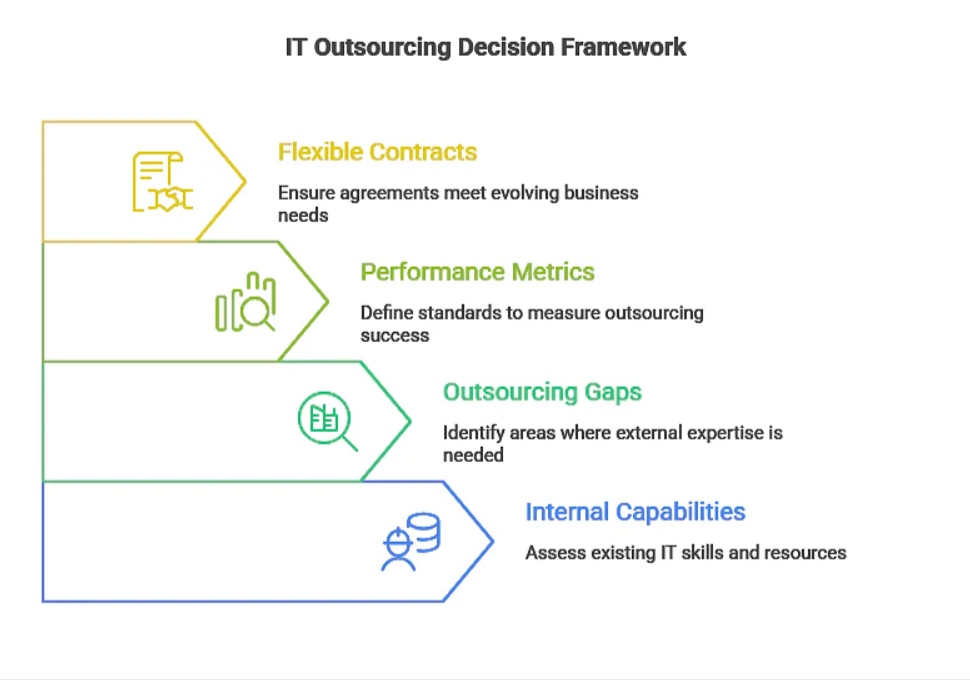
IT outsourcing has gone mainstream, with 49% of businesses using external providers. A structured framework helps determine if outsourcing makes sense for your company. The decision is not just about cost; it is about aligning IT with growth, risk management, and long‑term stability.
Here are 4 steps that guide the decision:
-
Internal Capabilities: Assess skills, bandwidth, and infrastructure. Identify where your team struggles to keep pace with growth or security demands.
-
Outsourcing Gaps: Decide which IT functions are strategic and should remain in‑house, and which tactical functions can be allocated externally for efficiency.
-
Performance Metrics: Define KPIs for uptime, response time, cost, and security. These benchmarks measure provider impact and ensure accountability.
-
Flexible Contracts: Choose agreements that allow scalability, transitions, and adjustments as your business evolves. Flexibility reduces dependency risk and keeps outsourcing aligned with future needs.
This framework ensures outsourcing decisions are deliberate, not reactive. By clarifying capabilities, defining gaps, and setting measurable expectations, leaders can confidently determine if outsourcing is the right fit for their business.
IT Outsourcing Solutions by Business Need
Many outsourcing benefits are obvious, but some require closer inspection. Different business challenges call for specific solutions, and mapping them clearly helps leaders see where outsourcing delivers the most impact:
|
Business Need |
Outsourcing Solution |
Key Benefit |
|
Cloud migration |
Specialized cloud provider |
Rapid deployment and reduced infrastructure cost |
|
Cybersecurity management |
Managed security services |
24/7 monitoring, advanced threat detection, and compliance readiness |
|
Peak season support |
Scalable IT service plan |
Temporary resource scaling with consistent performance during demand spikes |
|
Compliance audits |
Advisory and audit support |
Simplifies regulatory alignment and reduces penalties |
|
Backup and disaster recovery |
Automated failover & backup solutions |
Continuous access, fast recovery, and minimal downtime |
This table shows practical solutions that complement the broader benefits of IT outsourcing while reducing risk. Each one directly impacts operational efficiency, strengthens security, and improves cost control, giving businesses clarity and confidence in their IT strategy.
Harness IT Outsourcing Benefits with Trusted IT Support in Mississauga
The benefits of IT outsourcing go beyond cost savings. They provide predictability, expert coverage, and scalable support. When paired with proactive risk management, outsourcing becomes a strategic lever rather than a gamble.
AlphaKOR delivers enterprise‑grade IT solutions with measurable outcomes:
-
24/7 Monitoring: Continuous oversight to minimize downtime and keep systems running smoothly.
-
SLA Adherence: Proven reliability that gives leaders peace of mind.
-
Scalable Support: Flexible services that grow with your business needs.
By partnering with AlphaKOR, companies gain reliable IT infrastructure, local expertise, and enterprise‑grade support to scale confidently.
Contact a trusted IT support provider in Mississauga today to explore outsourcing options, secure your operations, and focus on growth without stretching your internal teams.


Contact Information:
AlphaKOR
2000 Argentia Rd 3, Suite #400
Mississauga, ON L5N 1V9
Canada
Brayden Dufour
+1 289-805-4735
https://alphakor.com/


Original Source: https://alphakor.com/benefits-and-risks-of-it-outsourcing/
